
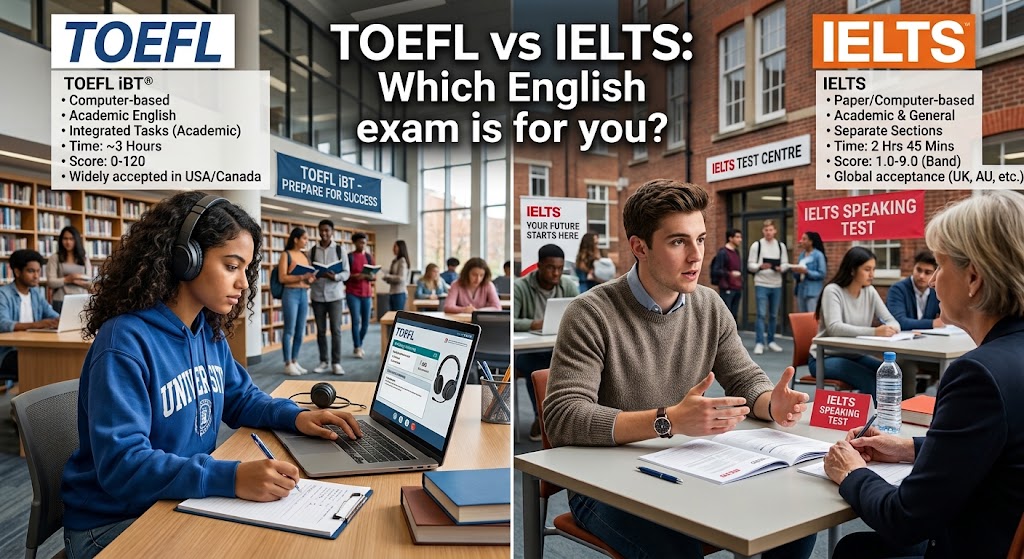
TOEFL vs IELTS: Which English Test Should You Take in 2026?
Choosing between TOEFL and IELTS is an important step if you want to study abroad, apply to an international university, immigrate, or demonstrate your English proficiency to an employer. Both exams assess your English skills, but they differ in format, speaking assessment, scoring, and test-day experience.
The best option is not necessarily the most popular test. It is the one accepted by your target institution or immigration authority and best suited to your strengths, budget, and preparation schedule.
In this TOEFL vs IELTS comparison for 2026, you will learn how the exams work, how their scores differ, what they typically cost, and which test may be better for your goals.
1. What Is the Difference Between TOEFL and IELTS?
TOEFL stands for Test of English as a Foreign Language, while IELTS stands for International English Language Testing System. Both are internationally recognized English proficiency tests, but they use different task formats and scoring systems.
Test of English as a Foreign Language
TOEFL iBT is designed primarily to assess English skills in academic settings. Tasks can include reading academic material, listening to lectures or conversations, speaking into a microphone, and writing responses on a computer.
Potential advantage: A fully computer-based testing experience with integrated academic tasks.
Official website: ETS TOEFL
International English Language Testing System
IELTS assesses listening, reading, writing, and speaking. IELTS Academic is commonly used for university admissions, while IELTS General Training is used for certain migration, employment, and training purposes.
Potential advantage: A speaking interview with an examiner in the standard IELTS test format.
Official website: IELTS Official
2. TOEFL vs IELTS: Comparison Table for 2026
Use this table to compare the main features before deciding which English test to take. Details can vary by test version, location, and the organization receiving your scores.
| Feature | TOEFL iBT | IELTS |
|---|---|---|
| Primary purpose | Academic English proficiency | Academic, general training, and certain migration purposes |
| Skills assessed | Reading, Listening, Speaking, Writing | Listening, Reading, Writing, Speaking |
| Speaking format | Responses recorded through a microphone | Usually an interview with an examiner; delivery options may vary |
| Reading and listening | Computer-based tasks | Paper or computer, depending on availability and format |
| Score system | New 1–6 scale in 0.5 increments introduced in 2026 | Band scores from 0 to 9 |
| Test duration | Approximately two hours; check current test details | Approximately 2 hours and 45 minutes for the main test components |
| Speaking experience | Speak to a computer | Speak with an examiner in the standard format |
| Acceptance | Widely accepted by universities and other institutions | Widely accepted by universities and other institutions |
| Cost | Depends on country and test location | Depends on country, test type, and test location |
Important: TOEFL introduced an updated scoring scale in January 2026. During the transition period, reports may also include a comparable 0–120 overall score. Confirm the current reporting format and score requirements directly with ETS and your receiving institution.
3. TOEFL vs IELTS Scoring: Which Is Easier to Understand?
One of the biggest differences between TOEFL and IELTS is how the results are reported. IELTS uses a familiar band scale from 0 to 9, while TOEFL iBT introduced a 1–6 scale in half-band increments in 2026.
How IELTS scoring works
IELTS reports a band score for Listening, Reading, Writing, and Speaking, as well as an overall band score. Results may use whole or half bands, such as 6.0, 6.5, 7.0, or 7.5.
For example, a university might require an overall IELTS score of 6.5 and a minimum of 6.0 in each component. Other programs may ask for higher scores or impose different minimums.
How TOEFL scoring works in 2026
TOEFL iBT reports results using a 1–6 scale in 0.5 increments under the updated scoring system. During the transition, ETS may provide a comparable overall score on the former 0–120 scale to help institutions interpret results.
Do not assume that a TOEFL score and an IELTS band have a perfectly interchangeable value. Use the official comparison guidance and, most importantly, the score requirements published by the institution you intend to apply to.
4. Which Test Is Easier: TOEFL or IELTS?
Neither TOEFL nor IELTS is universally easier. Your experience will depend on your English level, familiarity with academic vocabulary, typing speed, speaking confidence, and ability to work under time pressure.
TOEFL may feel easier if you…
- Are comfortable using a computer throughout an exam.
- Prefer recording spoken answers rather than talking to an examiner.
- Are familiar with academic lectures, university discussions, and integrated tasks.
- Can organize written responses and type efficiently under time limits.
- Prefer a structured testing environment with computer-based tasks.
IELTS may feel easier if you…
- Feel comfortable having a conversation with an examiner.
- Prefer a speaking interview over recording answers into a microphone.
- Need IELTS General Training for a specific migration or training pathway.
- Are familiar with the IELTS question types and band descriptors.
- Prefer to choose between available paper-based and computer-based formats, where offered.
Remember that personal preference does not replace preparation. Complete at least one official practice test for each exam before making your final choice. Compare your results and how comfortable you felt with the tasks.
5. TOEFL vs IELTS for University Admissions
If you are applying to a university in the United States, Canada, the United Kingdom, Australia, Europe, or another destination, the first question is not which exam is easier. It is which exams your program accepts.
Studying in the United States
TOEFL has a strong presence in US university admissions, but many institutions also accept IELTS. Requirements vary by university, department, degree level, and sometimes scholarship program.
Studying in the United Kingdom
Many UK universities accept IELTS and TOEFL for academic admissions. However, certain visa or immigration routes may require a specifically approved Secure English Language Test (SELT). An ordinary test accepted for university admission is not automatically valid for every visa purpose.
Studying in Canada or Australia
Both countries have institutions that accept English proficiency tests, but requirements depend on the university and the reason for testing. Immigration authorities can maintain different rules from universities. Check the exact test version, delivery format, and validity requirements for your application.
6. TOEFL vs IELTS for Immigration
If your goal is permanent residency, a work visa, or another immigration pathway, the correct exam depends on the destination country and visa category.
IELTS General Training is used for certain migration pathways, while IELTS Academic is often associated with university admissions and some professional registration requirements. TOEFL is accepted for many academic purposes, but it is not a universal substitute for an immigration authority's approved test.
Before paying for an exam, consult the official immigration website of the destination country. Confirm that the specific test, version, and test location are approved for your application.
7. TOEFL vs IELTS Cost: Which Is Cheaper?
There is no single worldwide price for either exam. Registration fees depend on your country, testing center, test format, and any additional services or rescheduling charges.
TOEFL costs to check
- Registration fee for your location.
- Rescheduling or cancellation fees.
- Additional score reporting fees, if applicable.
- Preparation materials or tutoring.
IELTS costs to check
- Academic or General Training registration fee.
- Paper or computer delivery options available locally.
- Rescheduling or cancellation charges.
- Preparation courses and practice materials.
When comparing costs, include transportation to the test center, accommodation if needed, preparation time, and the possibility of retaking the exam. A slightly more expensive test that suits your strengths may be more economical than paying to repeat a test that was not a good fit.
8. How to Prepare for TOEFL or IELTS
A realistic preparation plan should focus on the skills required by your chosen exam rather than general English study alone.
Step 1: Take a diagnostic practice test
Establish your current level before selecting a study plan. Use official sample questions and practice materials to identify weaknesses in reading, listening, speaking, and writing.
Step 2: Set a target score
Identify the minimum score for your university, employer, or visa application. Set a preparation target slightly above the minimum when possible, especially if each section has a separate requirement.
Step 3: Practice the exam format
TOEFL preparation should include computer-based tasks, timed responses, and speaking practice with a microphone. IELTS preparation should cover its listening formats, reading question types, writing tasks, and speaking interview structure.
Step 4: Improve academic vocabulary
Read articles, listen to lectures or podcasts, summarize arguments, and practice explaining complex ideas clearly. Focus on accurate grammar, useful vocabulary, logical organization, and clear pronunciation rather than memorizing complicated expressions.
Step 5: Simulate test-day conditions
Complete timed practice sessions without interruptions. Review your errors after each attempt and repeat the exercises that caused the greatest difficulty.
Step 6: Check registration requirements
Verify identification documents, test-day instructions, deadlines, result availability, and the score delivery process. If you are taking an at-home exam, confirm the equipment and environment requirements before booking.
9. Find the Right Test for Your Goals
Answer the following questions to receive a simple recommendation based on your preferences. This tool is a starting point, not an official eligibility or admissions assessment.
1. What is your main goal?
2. How do you prefer to demonstrate speaking skills?
3. Which test format appeals to you most?
10. Final Verdict: TOEFL or IELTS in 2026?
Choosing between TOEFL and IELTS comes down to your destination, application requirements, and personal strengths. Both can demonstrate strong English proficiency, and neither is automatically the best option for every candidate.
- Choose TOEFL iBT if your institution accepts it and you prefer computer-based academic tasks and recorded speaking responses.
- Choose IELTS Academic if your institution accepts it and you prefer its academic test format, including a speaking interview.
- Consider IELTS General Training if it is specifically accepted for your migration, work, or training pathway.
- Compare official practice tests if both options are accepted and you are unsure which matches your strengths.
The smartest strategy is to confirm the requirements first, take a diagnostic test, compare your performance, and register for the exam that offers the clearest route to your goal.
Frequently Asked Questions About TOEFL vs IELTS
Is TOEFL harder than IELTS?
Neither test is universally harder. TOEFL may be more comfortable for candidates who prefer computer-based academic tasks, while IELTS may suit those who prefer an examiner-led speaking interview. Your English level and familiarity with the format matter most.
Do universities accept both TOEFL and IELTS?
Many universities accept both, but policies vary by institution, course, and degree level. Confirm the accepted exams and minimum component scores on the official admissions page.
Which test is better for studying in the USA?
Both TOEFL iBT and IELTS are accepted by many US universities. Check your specific university and program before choosing.
Which test should I take for immigration?
It depends on the country and immigration category. Check the relevant government's official requirements because an exam accepted by a university may not be accepted for a visa.
How long are TOEFL and IELTS scores valid?
TOEFL and IELTS scores are generally valid for two years, but the organization receiving your results determines which scores it will accept and how recent they must be.
Can I take TOEFL or IELTS online from home?
Availability and acceptance of at-home testing depend on the exam, country, and receiving organization. Do not book a remote test until your institution or authority confirms that it accepts that format.
When should I book my English proficiency test?
Work backward from your application deadline. Allow enough time for preparation, score reporting, and a possible retake. Check current result timelines with the official test provider.
Can I compare TOEFL and IELTS scores directly?
Official comparison guidance can help institutions interpret results, but scores are not perfectly interchangeable. Follow the precise score requirements set by your university or organization.
Review the official requirements and preparation resources before booking your test.
Last reviewed: October 2026. Test rules, fees, delivery options, scoring policies, and institutional requirements can change. Always verify current details with the official providers and your receiving organization.