
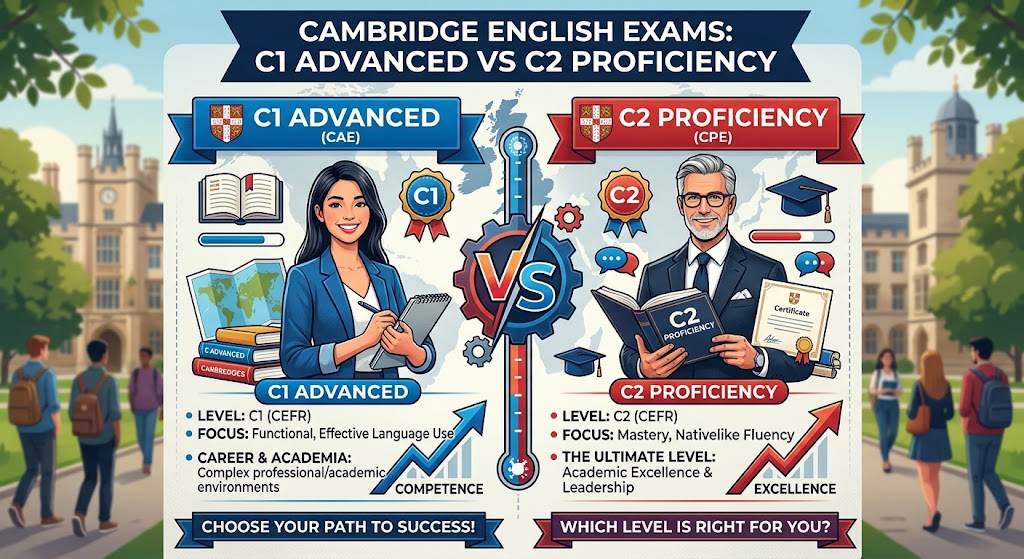
Choosing between Cambridge C1 Advanced and C2 Proficiency depends on your English level, academic plans, career goals and the requirements of the institution you want to apply to. Both are respected English qualifications, but they demonstrate different levels of proficiency. This guide explains the key differences and helps you decide which Cambridge English exam is right for you.
Cambridge C1 Advanced vs C2 Proficiency: At a Glance
The main difference is the level of English each qualification is designed to assess. C1 Advanced focuses on advanced English, while C2 Proficiency measures the highest level in the Cambridge English Qualifications range.
Cambridge C1 Advanced (CAE)
Best for learners who want to demonstrate strong English skills for university, professional communication and international opportunities.
Target level: C1
Cambridge English Scale: 180–199 for C1 performance
Exam duration: About four hours
Cambridge C2 Proficiency (CPE)
Best for learners who can use English with a high degree of precision, flexibility and sophistication in demanding academic and professional situations.
Target level: C2
Cambridge English Scale: 200–230 for C2 performance
Exam duration: About four hours
| Feature | C1 Advanced | C2 Proficiency |
|---|---|---|
| Common abbreviation | CAE | CPE |
| Target CEFR level | C1 — Advanced | C2 — Proficiency |
| Main purpose | Prove advanced English skills | Prove near-complete mastery of English |
| Reading and Use of English | 1 hour 30 minutes | 1 hour 30 minutes |
| Writing | 1 hour 30 minutes | 1 hour 30 minutes |
| Listening | About 40 minutes | About 40 minutes |
| Speaking | Usually around 15 minutes per pair | Usually around 16 minutes per pair |
| Overall exam time | About four hours | About four hours |
| Who should consider it? | Advanced learners seeking a widely recognized qualification | Very advanced learners seeking the highest Cambridge qualification |
Timing and administration details may vary slightly by delivery format and exam arrangements. Confirm the current format with your authorised exam centre.
What Is the Difference Between C1 and C2 English?
The Common European Framework of Reference for Languages (CEFR) describes language ability from A1, the beginner level, to C2, the highest level. Both C1 and C2 represent advanced English, but C2 requires greater control and flexibility.
What does C1 English mean?
At C1 level, you can understand demanding texts, follow complex discussions and express ideas fluently without frequently searching for words. You can usually use English effectively in university courses, meetings, presentations and professional correspondence.
A C1 learner can write structured essays and reports, defend an opinion and adapt their language to different situations. Occasional mistakes may still occur, especially with subtle meanings, idiomatic expressions or complex structures.
What does C2 English mean?
C2 represents a very high level of language proficiency. You can understand almost everything you read or hear with ease, combine information from different sources and express yourself precisely, even when discussing abstract, sensitive or highly complex subjects.
C2 users are generally better equipped to recognise subtle differences in meaning, understand implied ideas and adapt their tone to a specific audience. However, C2 does not mean that you must speak exactly like a native speaker or know every word in English.
Cambridge C1 Advanced vs C2 Proficiency: Exam Format
Both exams assess the four main language skills: reading, writing, listening and speaking. They also include Use of English tasks that assess grammar, vocabulary and control of language. The broad structure is similar, but the texts, tasks and expected level of performance differ.
1. Reading and Use of English
This paper assesses reading comprehension, vocabulary, grammar and your ability to understand how language works in context. You may need to complete gaps, transform words, understand long texts or identify specific information.
In C1 Advanced, the challenge is handling complex English confidently and accurately. In C2 Proficiency, you should be prepared for more demanding texts and subtler distinctions in vocabulary, meaning, tone and style.
2. Writing
Both exams require you to produce two written texts. Depending on the task, these may include essays, reports, reviews, proposals or other forms of writing.
For C1 Advanced, you need to organise your ideas clearly, develop arguments and use an appropriate register. C2 Proficiency expects an even more sophisticated command of structure, tone, precision and style. Understanding the task and addressing its purpose are just as important as using advanced vocabulary.
3. Listening
The listening paper includes different types of spoken material, such as conversations, interviews, talks and discussions. You need to identify main ideas, details, attitudes and opinions.
C2 candidates should be ready to interpret more nuanced meanings and follow complex arguments. Regular exposure to different accents, speaking speeds and authentic English content can help with both exams.
4. Speaking
The speaking test generally involves another candidate and two examiners. Candidates answer questions, express opinions, discuss prompts and work together on a task.
For C1 Advanced, aim for fluent, well-organised communication and the ability to collaborate. For C2 Proficiency, you should also demonstrate greater precision, flexibility and confidence when discussing abstract or complicated topics.
Cambridge C1 Advanced vs C2 Proficiency Scores
Cambridge English uses the Cambridge English Scale to report results. A candidate's score indicates the level demonstrated in the exam, so the qualification's target level and the final result are not always identical.
| Exam | Scale score | Reported level or grade |
|---|---|---|
| C1 Advanced | 200–210 | Grade A — C2 level |
| C1 Advanced | 193–199 | Grade B — C1 level |
| C1 Advanced | 180–192 | Grade C — C1 level |
| C1 Advanced | 160–179 | Performance at B2 level |
| C2 Proficiency | 220–230 | Grade A — C2 level |
| C2 Proficiency | 213–219 | Grade B — C2 level |
| C2 Proficiency | 200–212 | Grade C — C2 level |
| C2 Proficiency | 180–199 | Performance at C1 level |
These score bands help explain an important difference: you can demonstrate C2-level English by achieving Grade A in C1 Advanced. However, if a university or employer specifically requests the C2 Proficiency qualification, you should confirm whether a C1 Advanced result at C2 level meets its policy.
Which Cambridge Exam Should You Take?
Choose C1 Advanced if you want to study abroad
C1 Advanced is a strong option for students applying to universities where advanced English proficiency is required. It can demonstrate that you are prepared to follow lectures, read academic materials, participate in seminars and complete written assignments in English.
However, admission requirements differ between institutions and courses. Verify the accepted qualifications, minimum scores and any skill-specific requirements before booking an exam.
Choose C1 Advanced for professional opportunities
If you want to work in an international company, apply for a role that requires English or improve your professional profile, C1 Advanced may be sufficient. It demonstrates that you can participate in meetings, write professional documents and communicate confidently with colleagues and clients.
Choose C2 Proficiency for advanced academic goals
C2 Proficiency may be a good fit if you are planning demanding postgraduate study, research or academic work and want to demonstrate the highest level in the Cambridge English Qualifications range. First check whether your target programme requires C2 or simply accepts proof of C1 proficiency.
Choose C2 Proficiency if you already use English at a very high level
If you can understand complex texts with ease, express subtle distinctions and adapt your language to challenging situations, C2 Proficiency may be the right next step. It can also provide a clear personal goal if you want to refine your English beyond the advanced level.
Should you take C1 first and C2 later?
Not necessarily. You do not have to pass C1 Advanced before taking C2 Proficiency. If your current ability is already close to C2 and practice tests confirm that you are ready, you may choose to prepare directly for C2. If you are still building consistency at C1, taking C1 Advanced first may be a more practical option.
Find the Right Cambridge Exam for You
Answer these three quick questions for a general recommendation. This tool is for guidance only; it does not measure your actual English proficiency.
How to Prepare for C1 Advanced or C2 Proficiency
Although both exams assess similar skills, your preparation should match the exam you intend to take. Start with an official sample test and identify the areas where you lose marks.
1. Take a timed practice test
Complete sample tasks under realistic time limits. This helps you understand the format, build exam stamina and identify whether your current performance matches the level you are targeting.
2. Improve vocabulary in context
Read articles, essays and books, and note useful collocations, phrasal verbs and expressions. Focus on how words are used naturally rather than memorising long vocabulary lists without context.
3. Practise writing with clear criteria
Write essays, reports, reviews or proposals according to the tasks used in your exam. Check whether you have answered the question, organised your ideas logically, supported your arguments and used an appropriate tone.
4. Listen to authentic English
Use interviews, podcasts, lectures and discussions to practise following different speakers. Summarise the main ideas and listen again to identify details, attitudes and implied meanings.
5. Practise speaking with a partner
Practise giving opinions, comparing ideas, explaining your reasoning and responding to another speaker. Record yourself occasionally to identify repeated errors, unclear pronunciation or hesitation.
6. Use official preparation resources
Start with Cambridge English's official exam pages and sample materials. They can help you understand the format and assess the skills tested in each paper.
Frequently Asked Questions
Is C2 Proficiency better than C1 Advanced?
C2 Proficiency targets a higher CEFR level, but it is not automatically the better choice for every learner. If an institution accepts C1 Advanced and you meet its score requirements, C1 may be all you need.
Can I get a C2 level with C1 Advanced?
Yes. A Grade A result in C1 Advanced, corresponding to a Cambridge English Scale score of 200–210, demonstrates C2-level performance. Confirm that the organisation receiving your result accepts this qualification for its purpose.
Is C2 Proficiency much harder than C1 Advanced?
C2 Proficiency assesses a higher level of English, so its tasks generally require greater precision, flexibility and understanding of nuance. How difficult it feels depends on your existing language skills and experience with the exam format.
Do Cambridge C1 Advanced and C2 Proficiency certificates expire?
Cambridge English qualifications do not have a general expiry date. However, universities, employers and other organisations may impose their own rules about how recent an English test result must be. Check the policy of the organisation requesting your certificate.
Are both exams accepted by universities?
Both qualifications are recognised by many educational institutions and organisations worldwide. Acceptance and minimum scores vary by institution, course and purpose, so check the official requirements before deciding which exam to take.
Can I take C2 Proficiency without taking C1 Advanced?
Yes. You can register for C2 Proficiency without first passing C1 Advanced. The important consideration is whether your current English level and practice-test results suggest that you are ready for the C2 exam.
Which exam should I take if I am unsure of my level?
Try official sample tasks for both exams and assess your results across reading, writing, listening and speaking. A qualified English teacher or exam-preparation specialist can help you identify your current level and select a realistic target.
Make Your Cambridge Exam Decision with Confidence
For most learners who need advanced English for university or work, C1 Advanced is a practical starting point. If you already have excellent English skills and want to demonstrate the highest Cambridge qualification, C2 Proficiency may be the better fit.
Before registering, review the official exam format, take a practice test and confirm the exact requirements of the university, employer or organisation you have in mind.
Editorial note: Exam structures, score reporting and institutional requirements can change. Always consult Cambridge English and your chosen institution for the latest official information.