
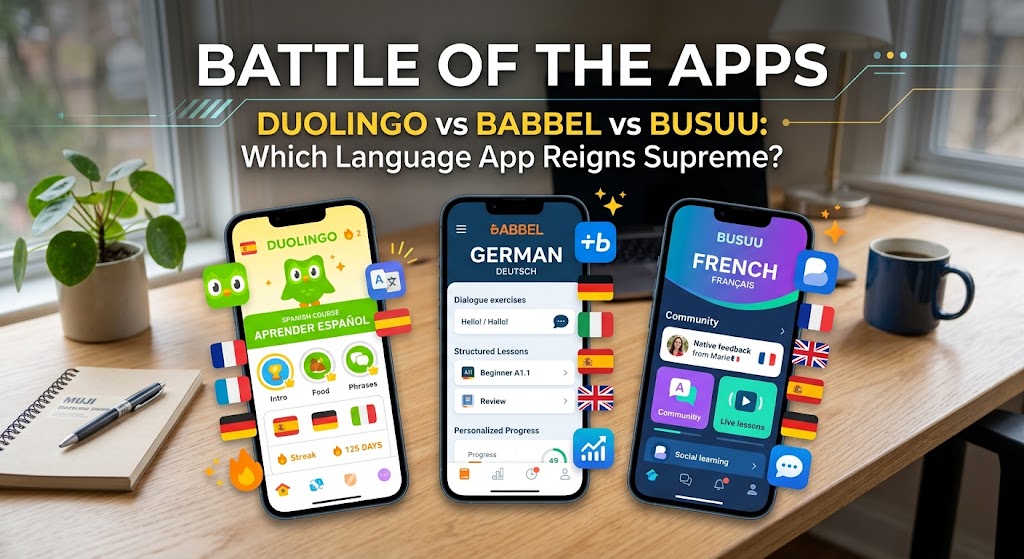
Choosing between Duolingo, Babbel, and Busuu can be confusing. All three help you learn a new language, but they use different teaching methods, offer different free features, and target different types of learners.
In this guide, we compare their lessons, speaking practice, grammar instruction, subscription value, and limitations so you can decide whether a paid plan is worth the money—or whether the free version is enough.
Compare the appsDuolingo vs Babbel vs Busuu: At a Glance
The biggest difference is the learning experience. Duolingo emphasizes short, game-like activities; Babbel uses structured lessons with explanations; and Busuu combines guided lessons with community features and optional premium tools.
| Feature | Duolingo | Babbel | Busuu |
|---|---|---|---|
| Best for | Daily habits and beginners | Structured lessons | Guided learning and feedback |
| Free access | Free courses with ads and restrictions | Selected free lessons and features | Free course access and community features |
| Grammar explanations | Available, but approach varies | A core strength | Guides and review tools; some require Premium |
| Speaking practice | Speaking exercises; extra AI features depend on plan and language | Speaking exercises and dialogues | Community practice; extra AI and pronunciation tools in Premium Plus |
| Community feedback | Not its main focus | Not its main focus | Yes |
| Subscription required? | No, but paid plans add features | For full course access, generally yes | No, but Premium unlocks additional tools |
| Best reason to pay | Remove ads and unlock extra practice features | Access the full structured course | Review tools, offline access, and optional speaking features |
Features depend on the language, device, region, and subscription tier. Check the official plans before paying.
Duolingo: Is Super Duolingo Worth It?
Best free optionGamified learningDaily practiceDuolingo is built around short lessons, points, streaks, progress goals, and game-like exercises. This approach can make language learning feel less intimidating and help you return to the app regularly.
Its free version is a major advantage. You can begin learning without committing to a subscription, which makes Duolingo a practical choice if you are unsure how consistently you will study.
What does Duolingo do well?
- Daily motivation: Streaks and reminders encourage regular practice.
- Easy entry point: Beginners can start with simple words and sentences.
- Short sessions: Lessons can fit into a break or commute.
- Free learning: Core courses remain available without a paid plan.
What are the limitations?
Game-like exercises do not always provide the depth needed for spontaneous conversation. If your goal is to speak comfortably at work, study abroad, or communicate with native speakers, you should supplement lessons with real listening and speaking practice.
Super Duolingo primarily improves the app experience by reducing interruptions and adding convenience features. Duolingo Max, where available, offers additional AI-powered features. Availability varies by language, country, and plan.
- Useful free version
- Easy to maintain a habit
- Beginner-friendly interface
- Short, accessible lessons
- Can feel repetitive
- Limited open-ended conversation
- Streaks are not the same as fluency
- Some advanced features are paid
Best for: Beginners, casual learners, and people who want a low-cost way to study daily.
Try DuolingoBabbel: Is the Subscription Worth the Cost?
Structured courseGrammar explanationsPractical phrasesBabbel is designed for learners who want a more organized path through a language. Lessons introduce vocabulary and expressions in practical contexts, with grammar notes that explain how sentences are constructed.
This approach can be useful if you prefer understanding why a phrase works rather than simply remembering the correct answer. Lessons often focus on situations such as travel, everyday interactions, and work-related communication.
What does Babbel do well?
- Structured lessons: Content follows a planned learning sequence.
- Grammar support: Explanations help clarify sentence patterns.
- Practical dialogues: Lessons focus on expressions you may use in everyday life.
- Review features: Vocabulary practice helps reinforce what you have learned.
What are the limitations?
Babbel's full self-study courses generally require a paid subscription. You can try selected lessons before purchasing, but free access is more limited than Duolingo's. Also, the number and depth of lessons vary by language.
Babbel is a course-based learning tool, not a guarantee of fluency. You will still need exposure to natural speech and opportunities to speak or write independently.
- Clear lesson progression
- Useful grammar notes
- Practical dialogues
- Review and supplementary content
- Full access requires payment
- Free lessons are limited
- Course availability varies
- Conversation outside the app is still necessary
Best for: Adults who prefer structured lessons, grammar explanations, and a more traditional course experience.
Explore BabbelBusuu: Is Premium or Premium Plus Worth It?
Guided learningCommunity feedbackPremium speaking toolsBusuu offers structured language courses and a community where learners can share exercises and receive feedback. This combination makes it appealing to people who want a clear learning path but also value input from other speakers.
Busuu offers different subscription levels. Its free option provides access to essential course content and community features. Premium adds tools such as grammar and vocabulary review, offline mode, and an ad-free experience. Premium Plus adds features including AI conversations and pronunciation feedback in supported languages and devices.
What does Busuu do well?
- Guided progression: Lessons are organized into a course.
- Community feedback: Learners can get corrections and suggestions from other users.
- Review tools: Paid plans include additional grammar and vocabulary practice.
- Optional speaking support: Premium Plus includes AI and pronunciation features where available.
What are the limitations?
Some of Busuu's most useful study tools are reserved for paid plans. Community feedback can also vary depending on how quickly other users respond and the quality of their corrections.
AI conversation and pronunciation features are not necessarily available in every language or on every device. Confirm that the feature you want is supported before selecting a subscription.
- Course-based learning
- Community corrections
- Grammar and vocabulary review on Premium
- Additional speaking features on Premium Plus
- Feature availability varies
- Some tools require a subscription
- Community response times differ
- Premium Plus may be unnecessary for some learners
Best for: Learners who want a structured course, feedback, and optional tools to improve speaking.
Compare Busuu plansDuolingo vs Babbel vs Busuu: Pricing and Value
The cheapest subscription is not automatically the best value. Think about the features you will actually use, whether you need a full course, and how much time you can realistically spend studying.
| App or plan | What you pay for | Who should consider it |
|---|---|---|
| Duolingo Free | No subscription fee for core courses; ads and limitations may apply | Anyone who wants to begin without paying |
| Super Duolingo | More convenient practice, fewer interruptions, and additional features | Regular users frustrated by limits or ads |
| Babbel subscription | Full self-study course access and learning tools | Learners who want structured lessons and explanations |
| Busuu Premium | Review tools, offline access, ad-free learning, and other course features | Learners who want a more flexible study routine |
| Busuu Premium Plus | Premium features plus additional speaking and AI tools where supported | Learners who will actively use pronunciation and conversation practice |
How much do they cost in 2026?
Subscription prices can differ by country, currency, promotion, billing period, and whether you subscribe through a website, Apple, or Google Play. For example, Babbel's official US pricing page has listed a 12-month plan at $107.40, billed in advance, with the monthly figure shown as an equivalent rate. That is an example, not a universal price.
Busuu's official plan comparison lists Free, Premium, and Premium Plus, but its checkout price depends on location, platform, and active offers. Duolingo's Super and Max pricing also varies by plan and market.
Before purchasing, check the final total rather than just the advertised monthly equivalent. Annual plans are often charged upfront, and subscriptions may renew automatically unless cancelled.
Which paid plan gives you the most value?
- Best value if you do not want to pay: Duolingo Free.
- Best for structured lessons: Babbel, if its course style suits you.
- Best for course plus feedback: Busuu, especially if you use community corrections.
- Best premium upgrade for speaking tools: Busuu Premium Plus, if the relevant features are available for your language and you will use them.
Which App Is Best for Learning English?
If English is your target language, all three apps can help you build a foundation, but the right choice depends on your current level and your goal.
- For everyday practice: Duolingo is an accessible way to establish a routine.
- For grammar and practical phrases: Babbel offers a more structured lesson experience.
- For course progression and feedback: Busuu provides guided lessons and community features.
If you are preparing for IELTS, TOEFL, a job interview, or university admission, combine your app with activities that match the actual task: timed reading, listening to longer recordings, writing essays, and speaking in extended answers. A general language app is not a complete exam-preparation plan.
Which App Should You Pay For? Take the Quick Quiz
Choose the answers that best describe your needs. The recommendation is based on your preferences, not on a claim that one app is objectively best for every learner.
How to Decide Before You Subscribe
Use a short trial period to test the learning experience before committing to a long subscription.
- Try the same language in each app. Course quality and available features can differ between languages.
- Complete several lessons. Decide whether the format makes sense to you and whether you want to return the next day.
- Test the feature you plan to pay for. If you want speaking practice, try it before upgrading.
- Check the total price. Confirm the billing period, currency, renewal date, and cancellation terms.
- Review your progress after two weeks. Can you remember phrases, understand more, or say something new without reading it?
One well-chosen app used consistently is usually a better starting point than paying for three subscriptions at once. Spend the extra time listening to real conversations, reading, writing, and speaking.
Final Verdict: Duolingo vs Babbel vs Busuu
Each platform offers a different kind of value. The best subscription is the one that solves a real problem in your learning routine.
- Choose Duolingo if you want to start for free and need motivation to practice regularly. Upgrade only if the paid features make a meaningful difference.
- Choose Babbel if you prefer structured lessons, grammar explanations, and practical dialogues—and you are comfortable paying for full course access.
- Choose Busuu if you want a guided course with community feedback and value its additional review or speaking tools.
Our overall recommendation: Start with Duolingo if budget is your main concern. Choose Babbel if clear explanations are your priority. Choose Busuu if you want a course combined with feedback and optional premium speaking features. Try the free options first, then pay for the features you know you will use.
Frequently Asked Questions
Is Duolingo better than Babbel?
Duolingo is better suited to free daily practice and gamified motivation. Babbel is a stronger fit for learners who want a structured course with grammar explanations and practical dialogues. The better option depends on your learning style.
Is Busuu better than Duolingo?
Busuu may suit learners who value guided courses and feedback from the community. Duolingo is attractive if you want a free, game-like way to practice daily. Both can be useful, but neither automatically replaces real-world communication.
Is Babbel worth paying for?
Babbel can be worth paying for if you want full access to its structured courses, grammar notes, and practice tools. Try the available free lessons first to make sure you like its teaching style.
Is Busuu Premium worth it?
Busuu Premium can be useful if you will use its grammar and vocabulary review tools, offline mode, and ad-free experience. Premium Plus may be more suitable if you specifically want its additional AI conversation and pronunciation tools in supported languages.
Can I learn a language with Duolingo for free?
Yes. Duolingo offers free courses. You may encounter ads or limits, and certain convenience or advanced features require a subscription, but paying is not necessary to begin learning.
Should I subscribe to all three apps?
Usually not at the beginning. Their core learning goals overlap. Choose one main app and use free resources for listening, reading, and conversation before considering another subscription.
Do these apps guarantee fluency?
No. Apps can help you build vocabulary, grammar knowledge, and study habits, but fluency also requires extensive listening, reading, writing, and interaction. Your progress depends on your starting point, practice time, and learning goals.
Editorial note: Prices, subscriptions, course content, and feature availability can change. Verify details on the official websites before purchasing. This comparison is educational and does not guarantee a particular language-learning outcome.